Back when I started out my professional career as a Data Engineer at inovex, many respected
seniors recommended the book 'Designing Data-Intensive Applications' by Martin Kleppmann. It was
praised as a great read
to both deepen your understanding of data storage internals and broaden your view for
the concepts that build up the architectures of modern data systems.
Apart from all the documentation, I didn't read too many technical books back then
so I was hesitant at first, questioning if that's a good way to spend my time.
But I gave it a try and from the beginning I absolutely loved it!
I was blown away by the great insights into so many concepts that govern
the technologies I work with everyday. Many of these I knew from my studies and
self-education but this book went deeper into what I felt are the relevant topics for
understanding data applications.
I recently reread the full book so I thought it
nice to pass on the recommendation to whoever is interested in deepening their
understanding of services available to the modern data tech-stack.
I guarantee that you'll learn something new about the internals of PostgreSQL, Kafka, ZooKeeper, and many more.
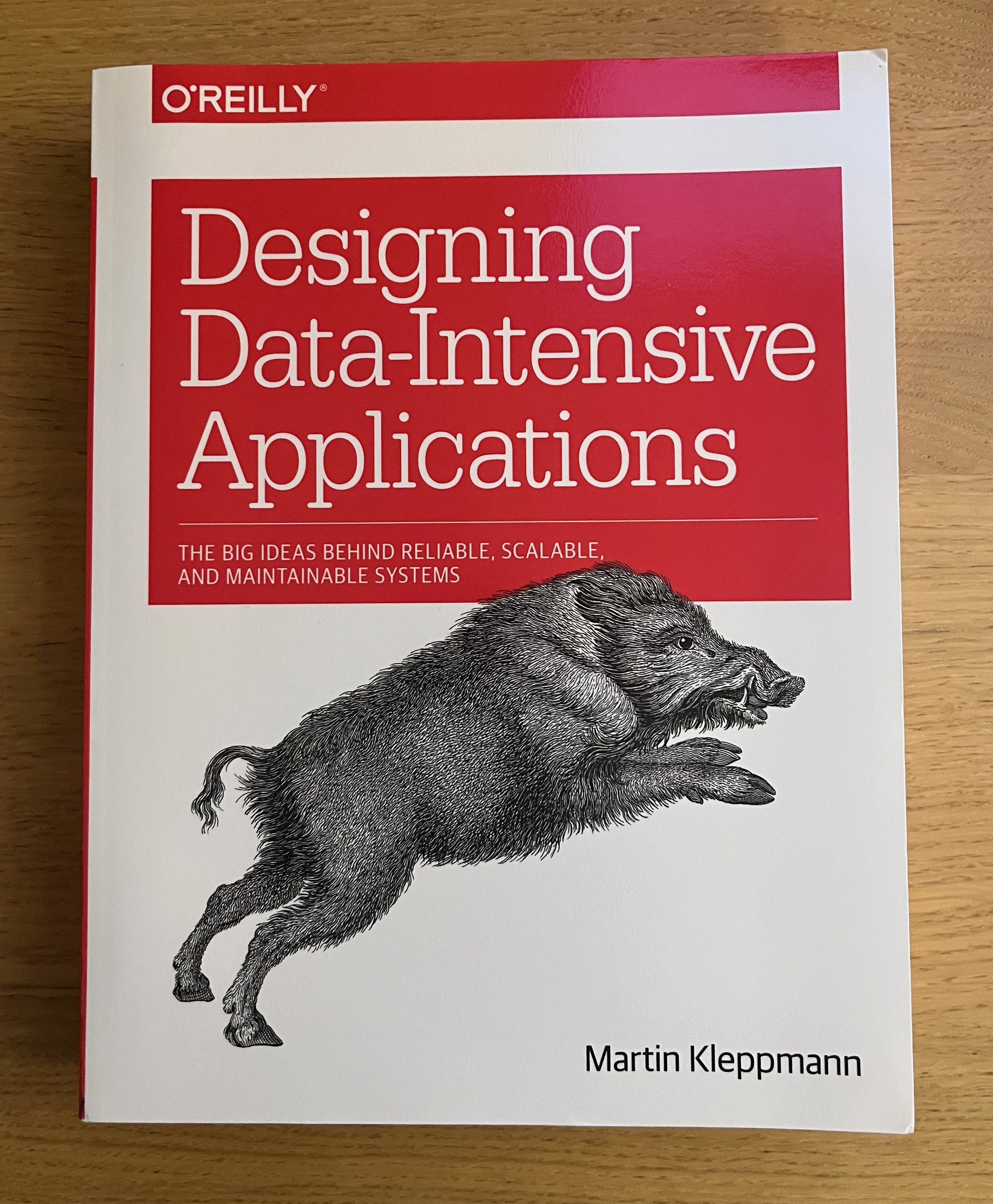 The typical O'Reilly-style cover. One can't not love it.
What do I think makes it stand out?
First, it's foundational and practical.
Kleppmann balances deep theoretical insights with practical advice, making complex topics accessible.
Whether you're a software engineer new to distributed systems or a seasoned architect, the
book provides value by bridging academic research and real-world applications.
Second, its broad scope.
The book covers a wide range of topics, including database internals, data modeling, distributed systems,
fault tolerance, consistency, and scalability.
This breadth makes it a comprehensive guide for anyone working with data processing systems.
I found myself many times, rereading parts when they became relevant on my current project or study.
Third, its comprehensibility.
The content is highly technical and hard to grasp at times. I would not recommend to read it after a
long day of cooking your brain at the office. Yet, I think that Kleppmann made a great job
explaining these concepts in a clear and understandable way, building up on previous
chapters as the book progresses.
What's covered?
Let me mention a few of my personal highlights while the table of contents is considerably longer. I recommend reading all chapters but it might take you a while to finish all 544 pages.
1. Storage Engines
Understanding how databases manage data on disk is helpful for also understanding their high-level properties. Kleppmann introduces log-structured merge trees (LSM) and B-trees, explaining how they underpin many popular storage engines. I never read about these underlying concepts in such detail before and think differently about databases ever since.2. Distributed Data Systems
Distributed systems are the backbone of modern applications, but they come with inherent complexity. Kleppmann dives deep into the related fields of replication, partitioning, transactions and consensus algorithms. For instance, he introduces common replication strategies and their trade-offs. Leader-based, multi-leader, and leaderless approaches each have pros and cons depending on consistency and availability requirements. Another chapter covers partitioning in detail. Dividing data across nodes improves scalability but introduces issues like skewed workloads, rebalancing, and concerns with consistency. I also really enjoyed the chapter on transactions. Kleppmann made me grasp the full scope of the challenges with the various isolation levels and conflicts.3. Consistency, Availability, and Partition-Tolerance
Just like in any extensive piece on distributed systems, the CAP theorem is discussed as well. Yet, Kleppmann explains his critical view on the theorem that's misunderstood a lot and offers other strategies for making informed trade-offs. In general, I think the book does a great job explaining doubts with many marketed guarantees.So who should read it?
Software Engineers looking to deepen their understanding of databases and distributed systems.System Architects needing to design scalable, fault-tolerant applications.
Data Engineers aiming to optimize data pipelines and storage systems.
Technical Leaders seeking to guide their teams in making sound design decisions.
If you're serious about building systems that stand the test of time, I'm convinced this book deserves a prominent spot on your shelf.
PS: I have no affiliation with Martin Kleppmann or O'Reilly (unfortunately!)